
How an AI Teacher Personalizes Learning: Inside Adaptive Learning
Personalized learning starts the moment a student answers a question. An AI teacher reads how you answer, builds a live model of what you know, and then changes the next question, hint, and lesson to fit you — that continuous adjustment is what educators call adaptive learning.
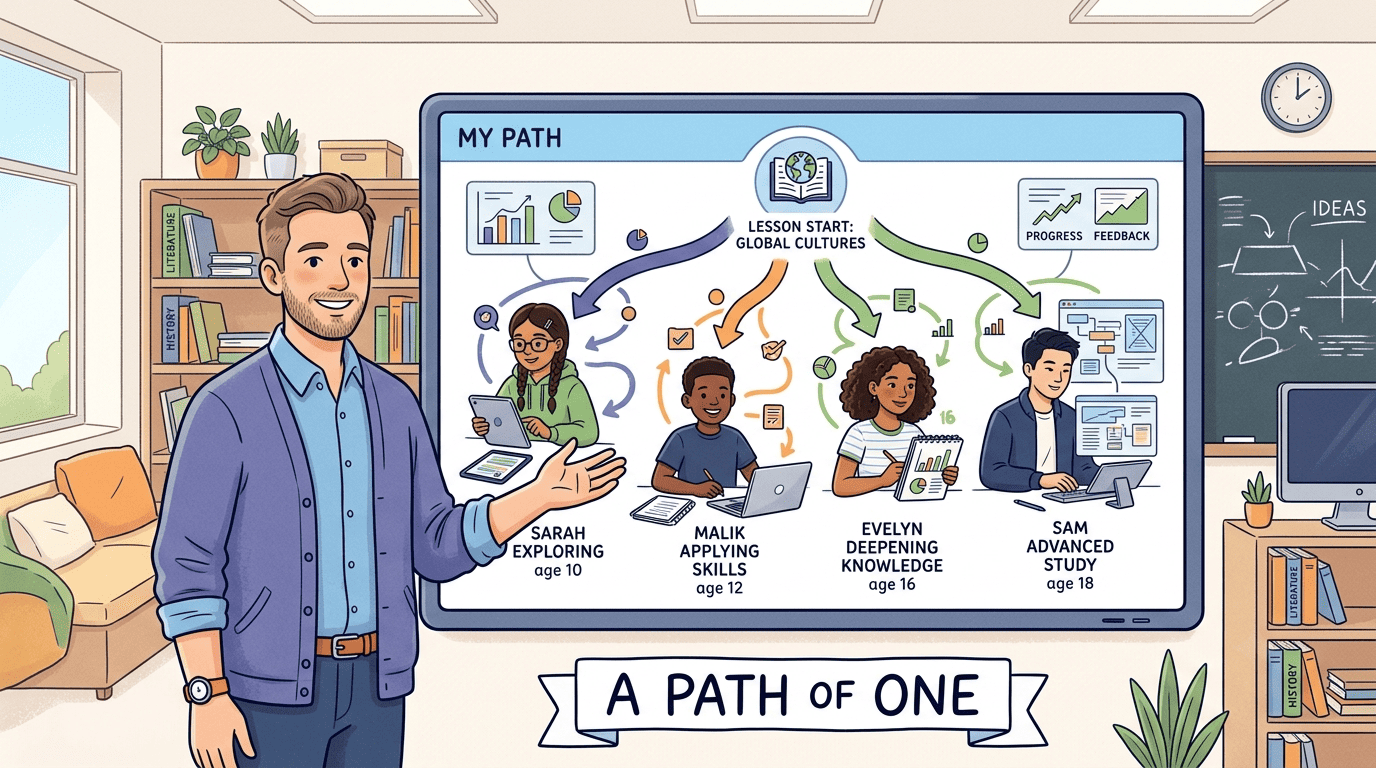
A single human tutor works with one student at a time, and a classroom teacher typically manages 20 to 30 students on one shared pace — an adaptive AI tutor instead holds a separate trajectory for every learner at once. The rest of this article walks through the mechanism step by step: the data it reads, the model it builds, the algorithms behind it, how difficulty and pace actually shift, and the feedback loop that keeps refining all of it.
What “AI teacher” and “adaptive learning” actually mean
Before getting into the mechanics, it helps to separate two terms that get used almost interchangeably but describe different things — one is the software, the other is the process it runs.
An AI teacher in one sentence
An AI teacher is software that teaches and adapts: it reads a student’s responses, updates a learner profile after each one, and changes what comes next based on that profile. The idea traces back to intelligent tutoring systems (ITS), a decades-old academic field that studies how software can model a learner’s knowledge and respond to it individually — the same lineage that today’s AI teacher, AI tutor, and adaptive AI tutor tools all draw on. Some products lean into the phrase “AI-powered personalized learning,” others call themselves an intelligent tutoring system directly, but the mechanism underneath is the same loop of read, model, adjust.
Adaptive learning is the mechanism, personalization is the goal
Personalized learning is the broad goal: content shaped around a student’s pace, interests, and gaps. Adaptive learning is the specific mechanism that gets there — a system that changes difficulty and sequencing on its own, based on real-time data, without a person deciding each step manually. Differentiated instruction shares the same intent as personalization, but a teacher makes those calls by hand for groups of students rather than for each one individually.
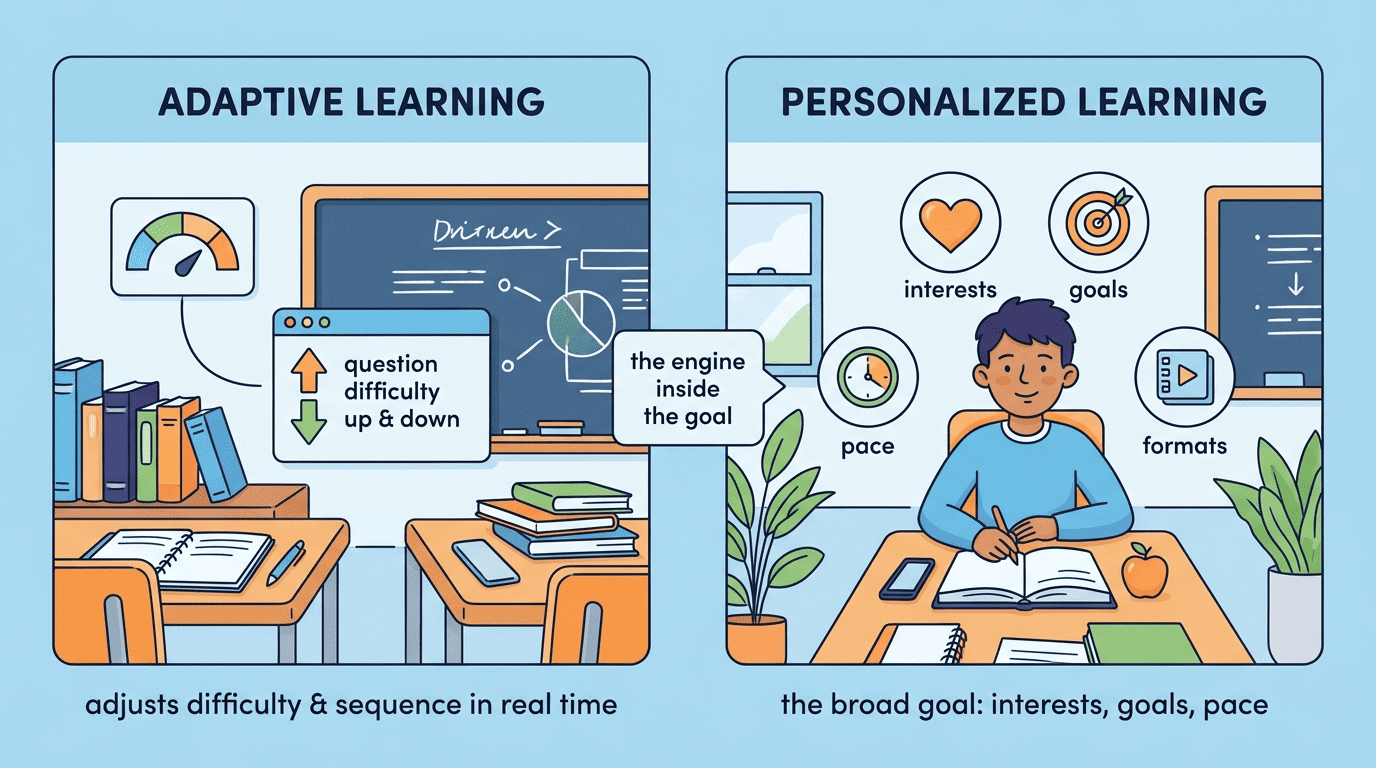
The scale problem is what makes automation matter here. A live tutor can only work with one student at a time, and a classroom teacher is typically stretched across roughly 20 to 30 students following one shared pace. Immediate, individually-targeted adjustment for every single learner simultaneously is the piece an AI teacher adds that neither format can offer at that scale.
How an AI teacher reads a student in real time
Personalization only works if the system has something to personalize against — that starts with continuously collecting signals from how a student actually works through material, not just whether they got an answer right.
The signals it collects
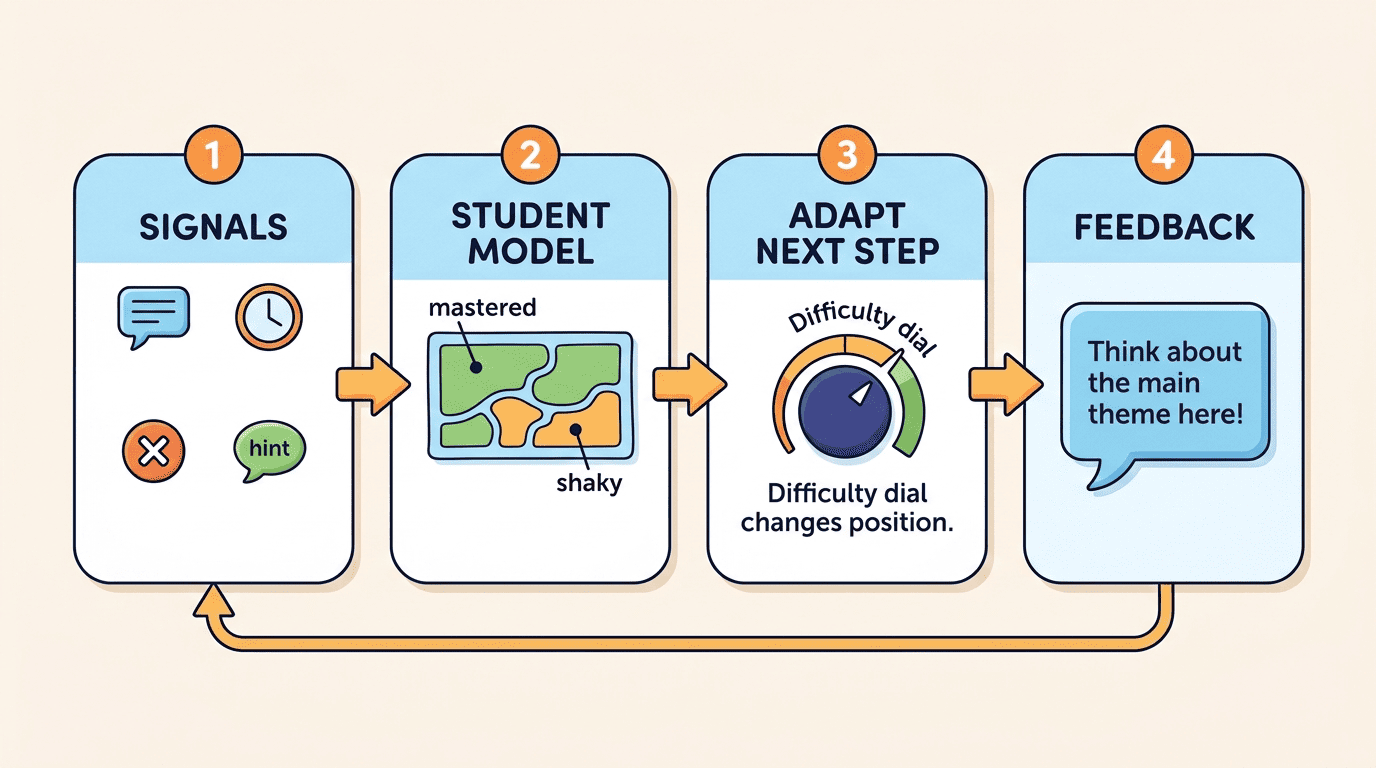
An AI teacher reads several concrete inputs as a student works, none of it tracked for its own sake — each one exists purely as input for the model that decides what to show next:
- Whether each answer is correct
- The specific type of error made (careless slip vs. genuine misconception)
- How long the response took
- How many attempts were needed
- Which hints were requested
- The recurring pattern of mistakes on a given topic
A good AI teacher online turns these signals into a running picture of a student’s strengths and gaps rather than a single pass/fail score.
The student model (learner profile)
The student model is a living map of what a learner knows and where the edge of that knowledge sits. Many platforms start with a short diagnostic to calibrate the initial estimate — DreamBox, for example, runs an opening assessment of roughly 15 to 45 minutes before adaptive lessons begin. From there, the model updates after every single response, not just at test time. Dashboards built on top of this model typically surface topic-by-topic mastery, pacing, and behavioral patterns like hint-seeking or repeated retries, giving both the system and a human teacher a shared view of progress.
The adaptive algorithms behind the scenes
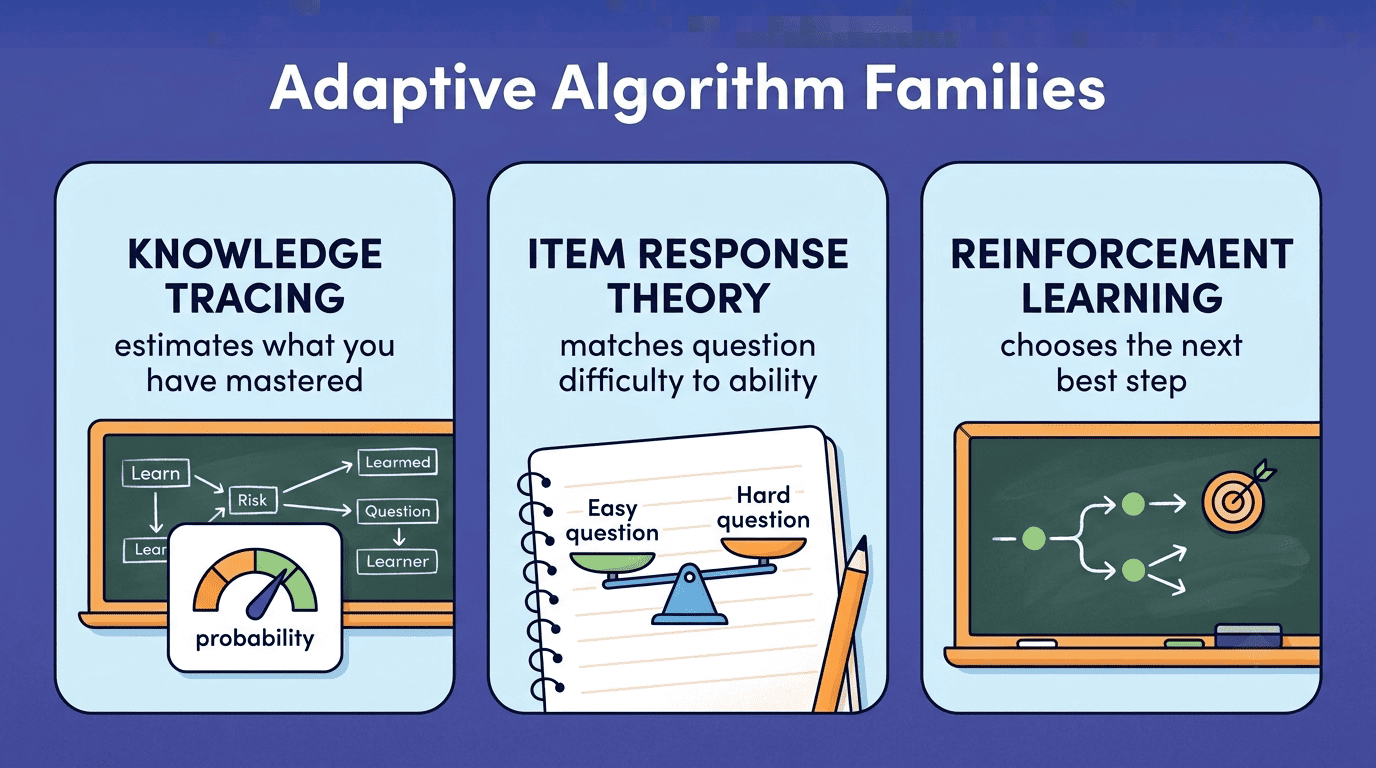
Behind the student model sit a handful of machine learning and statistical techniques that turn raw response data into a decision about what to show next. Three families do most of the work.
| Algorithm family | What it estimates | Typical use |
|---|---|---|
| Knowledge tracing (BKT / DKT) | Probability a student has mastered a specific skill | Deciding when a topic is “done” |
| Item Response Theory (IRT) | Question difficulty and student ability together | Picking the next question at the right difficulty |
| Reinforcement learning | Which next step maximizes learning, not just “next in list” | Sequencing lessons and topic order |
Knowledge tracing: estimating what you know
Bayesian Knowledge Tracing (BKT), developed in the 1990s, estimates the probability that a student has mastered a skill based on their history of correct and incorrect answers. Deep Knowledge Tracing (DKT) is a neural-network-based successor that can track hundreds of individual knowledge components at once instead of one skill at a time. Put simply, the system is constantly recalculating “how much of skill X does this student actually have right now” rather than relying on a single test score.
Item Response Theory: picking the right-difficulty question
Item Response Theory (IRT) is the same mathematical approach used in standardized adaptive tests such as the GRE: it jointly estimates how hard a question is and how capable the student is, so the system can serve items right at the edge of what that student can currently handle — hard enough to be useful, not so hard it stalls progress.
Reinforcement learning: sequencing the next best step
A reinforcement-learning approach chooses the next step that is likely to maximize learning, rather than simply moving to the next item on a fixed list. The underlying goal connects back to a well-known idea in education: keeping a student inside their zone of proximal development — the zone where a task is challenging but achievable with the right support, not so easy it’s boring and not so hard it’s discouraging.
How difficulty, pace and path actually change
An adaptive AI tutor works with three adjustable dials rather than one fixed setting for the whole class.
Three dials: difficulty, pace, path
Difficulty is how hard the next task is. Pace is how many repetitions a student gets before moving on. Path is the order and choice of topics presented. A typical rule looks like this: a run of correct answers pushes the system toward harder material and faster progression; a repeated mistake on the same concept triggers a hint, a worked explanation, or a step back to a prerequisite skill. In a math context specifically, this three-dial approach is what lets an AI teacher for math move a student between arithmetic, fractions, or algebra practice without waiting for a fixed unit schedule.
Mastery over seat time
An adaptive system advances a student based on demonstrated mastery rather than a fixed calendar. Students who move quickly aren’t held back waiting for the rest of the group, and students who need more repetition get it without being rushed forward before they’re ready — the pacing follows mastery-based learning rather than a bell schedule.
Predicting struggles before they happen
Predictive analytics looks at patterns in a student’s responses — timing, error type, hint use — to forecast where they’re likely to get stuck before it actually happens. The system can then surface extra scaffolding automatically or flag the student to a human teacher for earlier, more targeted intervention.
Feedback loops that keep improving
Real-time reading of a student and algorithmic sequencing only matter if the feedback that follows each answer is fast and specific enough to actually change what the student does next.
Instant, specific feedback
Unlike a graded assignment returned days later, an AI teacher can respond the moment a student submits an answer. With generative AI and natural language processing, that response has moved beyond a bare “correct” or “incorrect” — it can walk through why an answer was wrong and ask a guiding question in a Socratic style, pushing the student toward the answer rather than just handing it over. Instant, specific feedback is widely considered one of the biggest single drivers of the effect adaptive systems have on learning.
The loop that compounds
Each response refines the student model, which refines the next question or hint, which in turn generates a new signal for the model. Over time, this loop makes the system’s read on a student increasingly accurate. It’s this same accumulating loop that, over weeks of sessions, is what allows AI teacher study plans to shift from generic topic lists to something shaped around one student’s actual gaps and pace.
What the evidence shows (and what to expect)
The numbers below come from specific studies and should be read as ranges tied to particular subjects and implementations, not universal guarantees.
Measured gains
Reported effects vary by study and subject, and should be treated as ranges rather than promises. A study of a Harvard physics course, conducted in fall 2023 and published in 2025, found students learned measurably more, in less time, when working with an AI tutor than in an active-learning lecture format. A broader systematic review covering 28 studies and roughly 4,597 K-12 students found generally positive but highly variable effects — individual comparisons ranged from small to large depending on what the AI tutor was compared against, and the review’s authors noted the study designs varied too much to reduce to one clean number. Other individual studies report gains such as a 4 to 9 percentage-point increase in topic mastery. Some ed-tech vendors also cite students progressing roughly 30 to 50% faster on Khan Academy-type platforms — that figure comes from vendor marketing material rather than a peer-reviewed study, so treat it as a directional claim, not a benchmark. None of these figures should be read as a guarantee for any specific student or classroom — results depend heavily on the subject, how the tool is implemented, and how consistently it’s used.
Technology, including generative AI, should not replace the valuable relationship between teachers and pupils.
UK Department for Education, Generative AI in education
Time given back to teachers
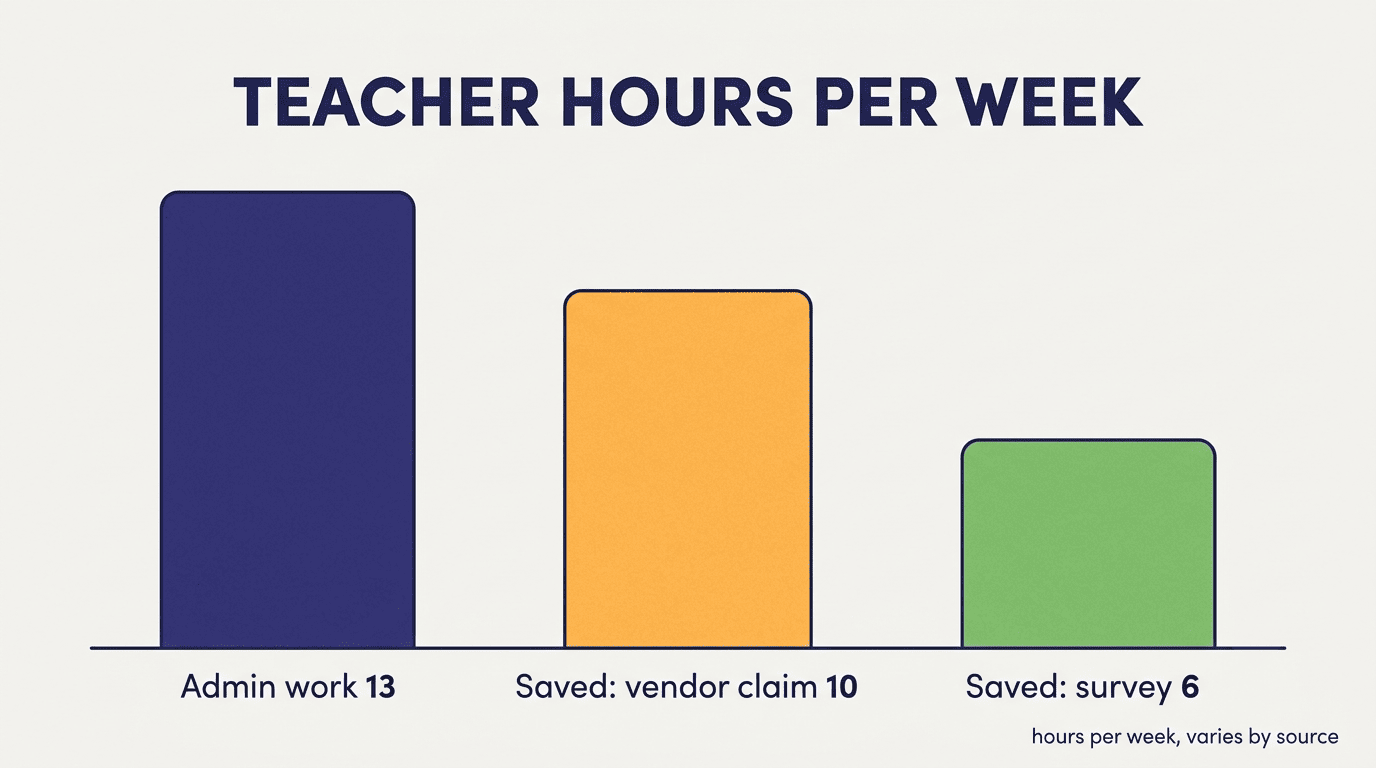
Teachers report losing roughly 13 hours a week to administrative tasks, and reported time savings from AI tools vary widely — surveys of general classroom use put the typical figure around 6 hours a week, while some individual vendors claim up to 10 hours when tasks are more fully automated. The tasks most commonly offloaded to an AI teacher include:
- Grading routine practice and quizzes
- Drafting differentiated practice sets for different ability levels
- Flagging students who show early signs of falling behind
- Generating progress summaries for parent-teacher conversations
That reclaimed time is generally redirected toward direct, one-on-one work with students rather than paperwork.
Real adaptive learning platforms (examples)
Several existing products illustrate the same mechanism in different subjects.
| Platform | Subject focus | How it adapts |
|---|---|---|
| Khan Academy / Khanmigo | General K-12, LLM tutor | Combines adaptive exercises with an LLM-based conversational tutor |
| DreamBox | K-8 math | Diagnostic (15-45 min) plus continuous difficulty adjustment |
| Duolingo | Language learning | Adapts at massive scale — over a billion exercises completed daily |
| ALEKS | Math and science | Maps knowledge using knowledge-space theory |
A quick tour
Khan Academy pairs its adaptive exercise library with Khanmigo, an LLM-based tutor layered on top. DreamBox focuses on K-8 math, opening with a diagnostic of about 15 to 45 minutes before adjusting continuously from there. Duolingo applies adaptive sequencing to language learning at enormous scale, processing over a billion completed exercises a day to refine its models. ALEKS builds a knowledge-space map of a subject to decide what a student is ready to learn next. Each of these products reads a learner’s behavior and reshapes the path in front of them — the specific method differs, but the core loop is consistent across all of them.
Limits, privacy and the human-teacher role
Adaptive systems are genuinely useful, but they have real boundaries worth naming plainly, especially given that the students using them are often minors.
Where AI teachers fall short
Adaptation tends to work well on well-structured skills and less well on open-ended or creative work, where there’s no single correct next step to model:
- Works well: arithmetic, vocabulary, factual recall, procedural math and science
- Works poorly: open-ended essays, creative writing, discussion-based reasoning
- Contested claim: the idea that these systems adapt to a student’s fixed “learning style” (visual, auditory, and so on) is scientifically disputed
- What actually adjusts reliably: demonstrated skill level and specific knowledge gaps, not a perceptual preference
Models can also make mistakes or inherit biases present in their training data, which is why the claims above should be treated as tendencies, not guarantees.
Data privacy matters
An AI teacher runs on student data, and a meaningful share of that data comes from minors, which raises the bar on transparency, data minimization, and security. Families and schools evaluating any AI teacher online should understand what’s collected and how long it’s kept. In the US, the Family Educational Rights and Privacy Act (FERPA) sets the federal baseline for how student education records must be protected, and it’s a useful reference point when comparing tools.
AI teacher + human teacher
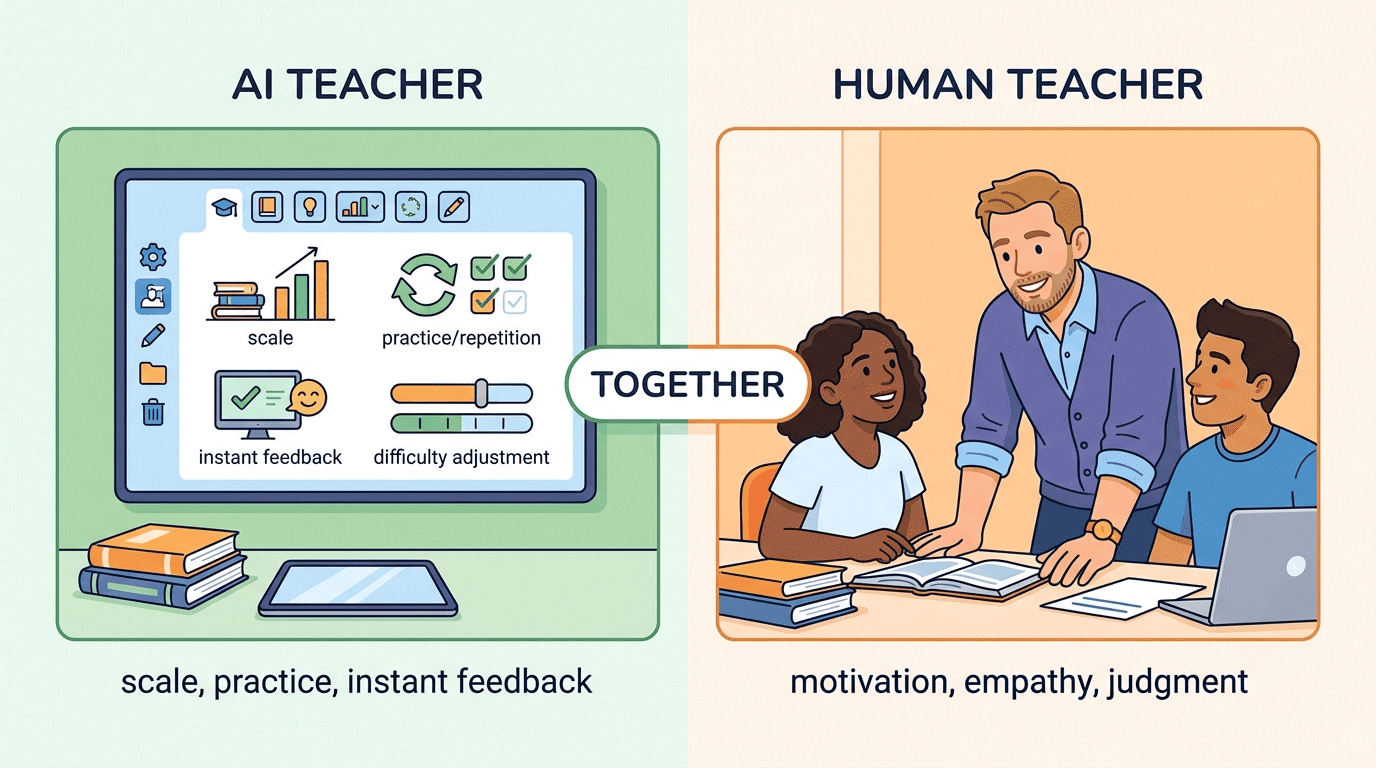
The clearest finding across the research and the platforms above is consistent: an AI teacher complements a human teacher rather than replacing one. Some researchers describe the software’s role as a “silent co-teacher” working alongside the classroom teacher. In practice, the two sides split the work along different lines:
- The AI teacher handles: scale, repetition, instant feedback, and moment-to-moment difficulty adjustment
- The human teacher handles: motivation, classroom context, empathy, and judgment calls that data alone can’t make
- Both share: watching the mastery dashboard and deciding when a struggling student needs a different kind of help entirely
The strongest outcomes come from the two working together, not from either working alone.
How to get started
- Start with a short diagnostic so the system can calibrate an accurate starting estimate of what you already know.
- Do short, regular sessions rather than occasional long ones — the feedback loop needs frequent data points to stay accurate.
- Track the mastery dashboard, not just how many lessons have been marked complete — mastery reflects actual retention, completion count doesn’t.
- Keep a human teacher or parent in the loop to interpret results, provide context, and step in where judgment is needed.
- Revisit the diagnostic periodically, since a student model that goes stale can start recommending the wrong level of difficulty.