
AI Teacher for Math: How an AI Tutor Actually Helps You Learn
An AI teacher for math is a patient, always-available tutor that walks you through every problem one step at a time — and, unlike a static answer key, it adapts to exactly where you get stuck. Meet Leo, the AI teacher built to explain math the way a good classroom teacher would: with worked steps, gentle hints, and instant feedback the moment you make a mistake.
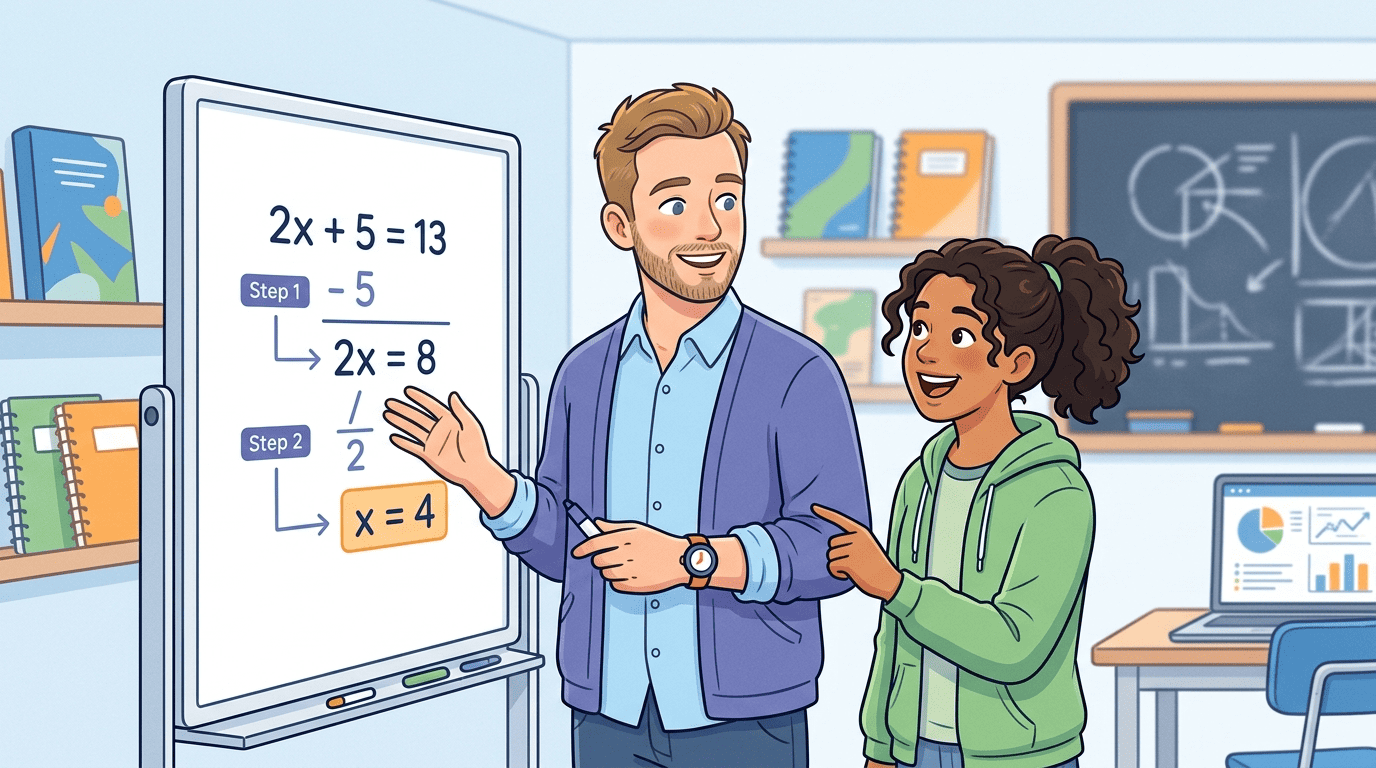
The short answer to “can AI teach math?” is yes — carefully. Used well, an AI math tutor turns a lonely homework struggle into a guided conversation; used carelessly, it can hand you a confident wrong answer. This guide shows what an AI teacher for math can really do, what the research says, and how to use one so it actually builds skill.
Can an AI Teacher Really Teach Math?
An intelligent tutoring system earns the word “teach” only if it does more than print a result. A solver prints the answer; an AI math tutor shows the reasoning and checks your understanding along the way — pausing to ask whether a step made sense before moving on. That distinction is no longer a fringe question: 86% of students worldwide already use AI in their studies, and 54% use it weekly, according to the DEC Global AI Student Survey (2024). The debate has shifted from whether students use AI to whether it actually teaches them anything.
The learning loop an AI-powered math tutor fits into is simple and old-fashioned:
- Understand the concept with the AI’s help
- Practice it by hand, without the AI
- Review your mistakes and repeat the tricky part
The AI explains and checks; mastery still comes from doing the problems yourself. The U.S. Department of Education’s guidance on classroom AI echoes the same principle, urging schools to keep “humans in the loop” rather than handing instruction over entirely.
How an AI Math Teacher Works
Under the hood, a conversational AI math tutor combines four behaviors that a plain calculator or search engine doesn’t offer:
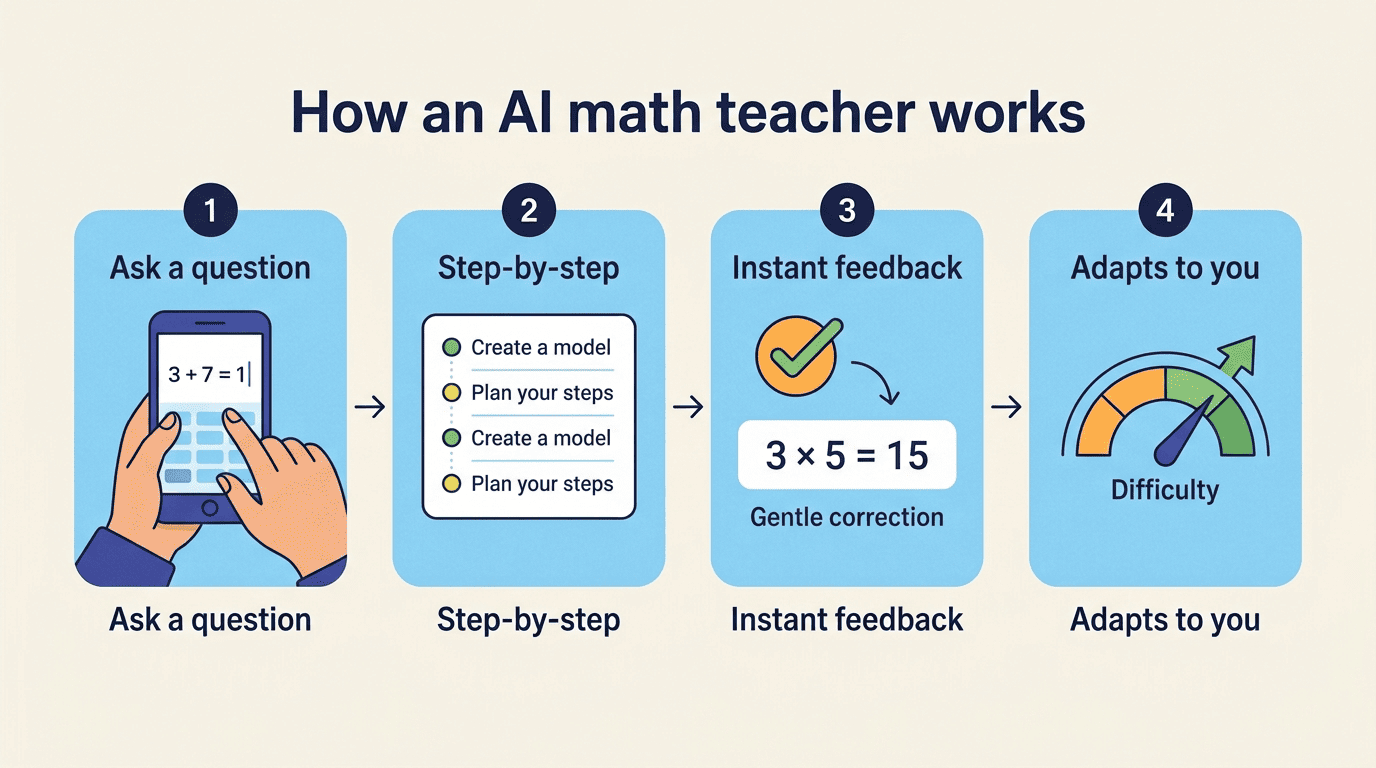
- Step-by-step explanations. A good AI math tutor breaks a problem into micro-steps and never skips the tricky one, and often offers more than one method — factoring versus the quadratic formula, for example — so you build flexible thinking rather than memorizing a single path.
- Adaptive difficulty and personalization. The system adjusts the next problem to your level in real time, easing off when you struggle and stretching you once you’re fluent. This real-time adjustment is the core of what makes an intelligent tutoring system different from a worksheet generator.
- Instant feedback and misconception diagnosis. Errors get corrected the moment they happen, and a well-built AI teacher names the specific misconception — a sign error, the wrong order of operations — instead of simply marking the answer wrong.
- Multiple input modes. You can type, paste, or snap a photo of handwritten work using optical character recognition, which is especially useful for geometry diagrams and multi-line word problems.
Where a virtual math tutor still needs a human check
Even a strong virtual math tutor benefits from a second look on multi-step algebra or calculus, since a single misread symbol early in a solution can cascade into a wrong final answer. Treat the AI’s walkthrough as a first draft of understanding, not a certificate of correctness.
What the Research Says About AI Math Tutoring
Independent studies on AI math tutoring are still young, but the early evidence is more encouraging than skeptics expected — and more modest than marketing pages suggest.
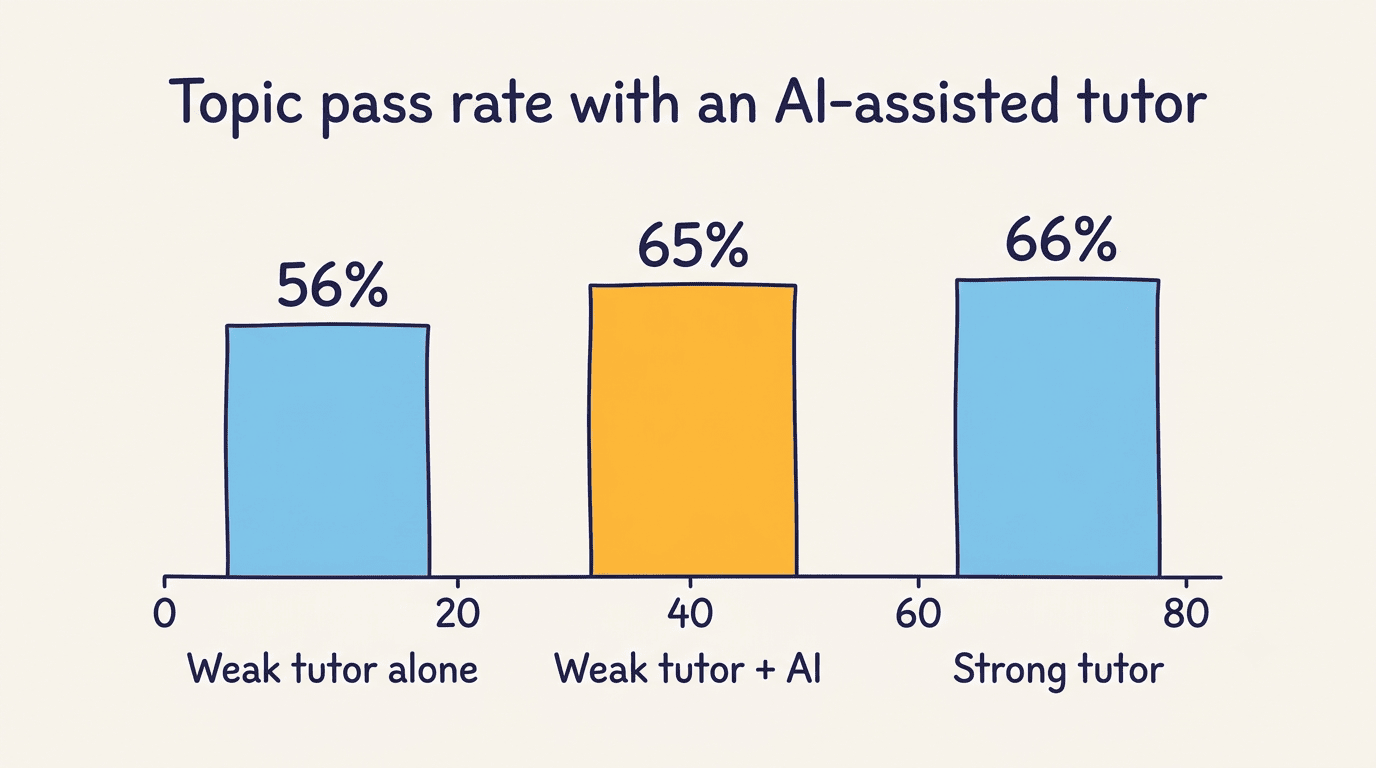
The first randomized controlled trial of a human-AI tutoring system, run at Stanford, involved about 1,800 K-12 students from historically under-served communities and roughly 900 tutors. Students working with AI-assisted tutors were 4 percentage points more likely to master a topic than students in the control group. The effect was strongest where it mattered most: for lower-rated tutors, the gain jumped to 9 percentage points, pushing their students’ pass rate from 56% to 65% — nearly matching the 66% pass rate of already highly-rated tutors — at a cost of roughly $20 per tutor per year.
We’re at the cusp of using AI for probably the biggest positive transformation that education has ever seen.
Sal Khan, founder and CEO of Khan Academy
Khan didn’t build Khanmigo as a novelty — his framing is that guided, patient tutoring is the piece traditional classrooms have never been able to scale to every student. Other classroom evidence points the same direction without erasing the caveats. Here’s how three of the better-known studies compare:
| Study / Tool | Sample size | Reported result |
|---|---|---|
| Stanford Tutor CoPilot (RCT) | ~1,800 students, ~900 tutors | +4pp topic mastery overall; +9pp for lower-rated tutors (56% → 65% pass rate) |
| ALTER-Math | 6,000 students | 1.56× the learning gains of the control group |
| Carnegie Learning Blended Algebra I (with MATHia) | 18,000+ students, 147 schools, 7 states (RAND study) | Nearly doubled typical algebra learning growth in year two |
Read these as promising, context-dependent signals rather than a guarantee — the size of the gain still depends heavily on how the tool is used and how much human support surrounds it.
Best AI Tools a Math Teacher (or Student) Can Use
Not every AI math tool plays the same role. Some are built to teach; others are built to compute or check an answer fast.
Conversational tutors
Khanmigo, built by Khan Academy on GPT-4, uses Socratic questioning and is free for U.S. teachers, making it one of the most accessible options for guided, curriculum-aligned help. Leo sits in this same category: a conversational AI teacher for math that asks questions before it gives answers.
Camera solvers and computational engines
Photomath scans a handwritten problem with your phone camera and shows the steps behind the solution, while Wolfram Alpha remains the computational gold standard for algebra, calculus, and statistics. Mathway, Symbolab, and Microsoft Math Solver round out the field of quick-answer tools that lean more toward solving than teaching.
| Tool | Type | Best for | Key feature |
|---|---|---|---|
| Khanmigo | Conversational AI tutor | Guided, curriculum-aligned help | Socratic questioning; free for U.S. teachers |
| Photomath | Camera solver | Scanning handwritten homework | Step-by-step camera scan |
| Wolfram Alpha | Computational engine | Advanced algebra, calculus, statistics | Deep computational engine |
| Mathway | Quick solver | Fast answers across topics | Broad subject coverage |
| Symbolab | Quick solver | Step solutions for algebra and calculus | Practice-problem generator |
| MATHia | Adaptive learning platform | Classroom-scale personalized practice | Grades 6-12; tied to a RAND study showing nearly doubled algebra growth |
Limits and Risks You Should Know
An AI math solver is a tool, not an oracle, and treating it as infallible is where most of the real trouble starts. Three risks matter most before you hand a student an account:
- Confidently wrong multi-step answers (hallucinations)
- Student data privacy under COPPA and FERPA
- Over-reliance that quietly weakens problem-solving skills
Hallucinations and wrong steps
General-purpose chatbots can produce a confident but wrong multi-step solution, and some still fumble basic multiplication above 12×12. According to Wikipedia’s entry on intelligent tutoring systems, reliably diagnosing a student’s specific error — rather than just flagging that an answer is wrong — is one of the harder design problems in the field. Always verify the final answer and treat the AI as a guide, not the last word.
Data privacy for students
Tools used by children under 13 need parental consent under COPPA, and schools must weigh FERPA obligations before adopting any AI platform. Favor education-grade tools with a clear, published privacy policy over general-purpose consumer chatbots.
Over-reliance
Leaning on AI to do the thinking can quietly weaken problem-solving skills over a semester. The fix is procedural, not willpower: use the AI to understand a method, then close the chat and practice unaided.
AI Teacher vs. Human Teacher: Complement, Not Replacement
The honest framing isn’t AI versus teacher — it’s AI plus teacher, each doing what it’s better at.
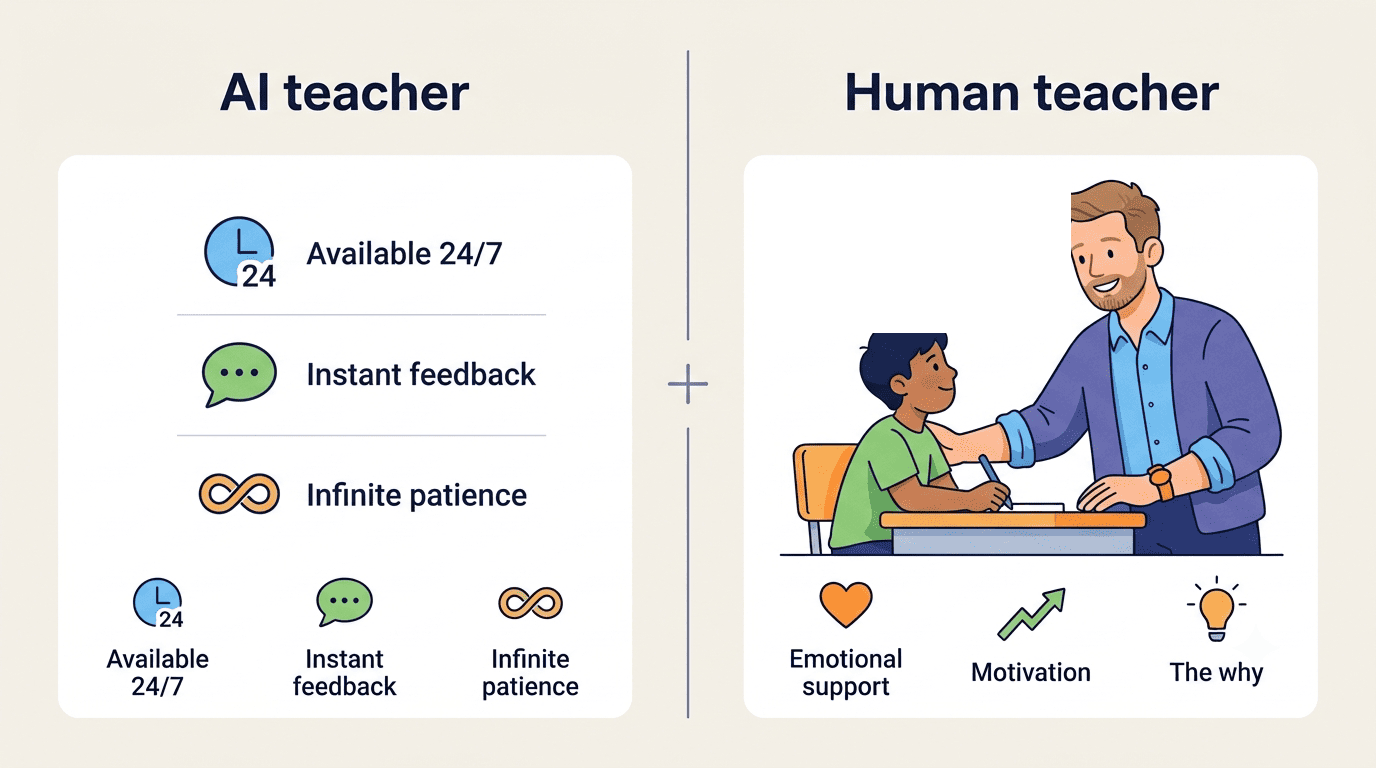
Where AI wins:
- On-demand availability, any hour
- Infinite patience on repeated questions
- Instant, consistent feedback
- Low cost per student at scale
Where humans win: emotional support, motivation, explaining the “why” behind a recurring mistake, and reteaching a foundation the student never fully grasped the first time.
| What AI does better | What a human teacher does better |
|---|---|
| Available 24/7, no waiting for office hours | Reads frustration and adjusts tone in the moment |
| Infinite patience on repeated questions | Builds long-term motivation and trust |
| Instant, consistent feedback on every step | Reteaches a foundational gap from scratch |
| Low cost per student at scale | Provides emotional and social support |
The National Council of Teachers of Mathematics takes the same position in its official statement on AI in mathematics education: AI-based tools complement rather than replace mathematics teachers, and students still need a critical eye for AI’s errors and hallucinations.
How to Use an AI Math Teacher Well
Getting real value out of an AI math coach comes down to a small set of habits, not a special prompt or paid tier.
Ask for reasoning, not just answers
Prompt it to explain each step and to quiz you back rather than just handing over a final number. This is where AI tutor support shines — turn every solved problem into a mini-lesson instead of a copy-paste answer.
A simple loop that actually builds skill
- State the problem in your own words before typing it in.
- Ask the AI teacher to walk through the first step only, not the full solution.
- Try the next step yourself, then check it against the AI’s explanation.
- When you get stuck, ask “why,” not just “what’s the answer.”
- Once the concept clicks, close the chat and solve a similar problem by hand.
- Have the AI check your unaided work and name any misconception it finds.
- Repeat with a slightly harder problem the next day to confirm it stuck.
Build the practice habit around that loop: use the AI to understand, then do a set of problems by hand and have it check your work afterward. That order — understand, then practice unaided, then verify — is what separates real learning from a faster way to finish homework.