The AI Teacher and the Socratic Method: How It Asks Instead of Answers
A student pastes a homework problem and expects the fix. Instead, an AI teacher writes back a question: “What have you already tried, and why did you expect it to work?” That’s not a dodge — it’s the Socratic method, and a well-built AI-powered teacher uses it on purpose, holding the answer back until the student’s own reasoning gets there, much as Socrates did in the dialogues Plato recorded.
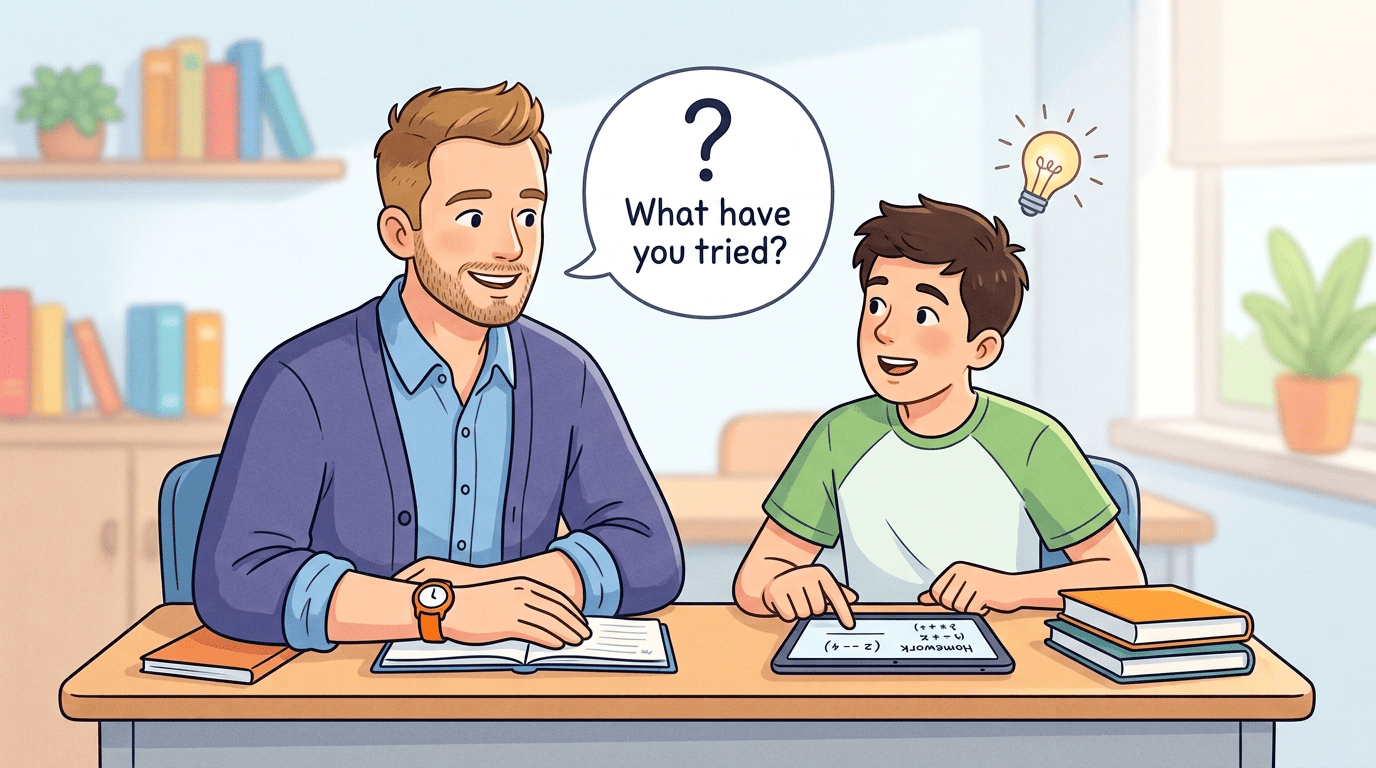
The point isn’t to make homework harder for its own sake. It’s the difference between a student who copies a solution and one who can reproduce the reasoning a week later without help. This article walks through what the Socratic method actually is, how an AI tutor runs the dialogue, the specific question pattern it follows, why the science favors asking over telling, which tools already do this, and where the approach runs into real limits.
What the Socratic Method Actually Is
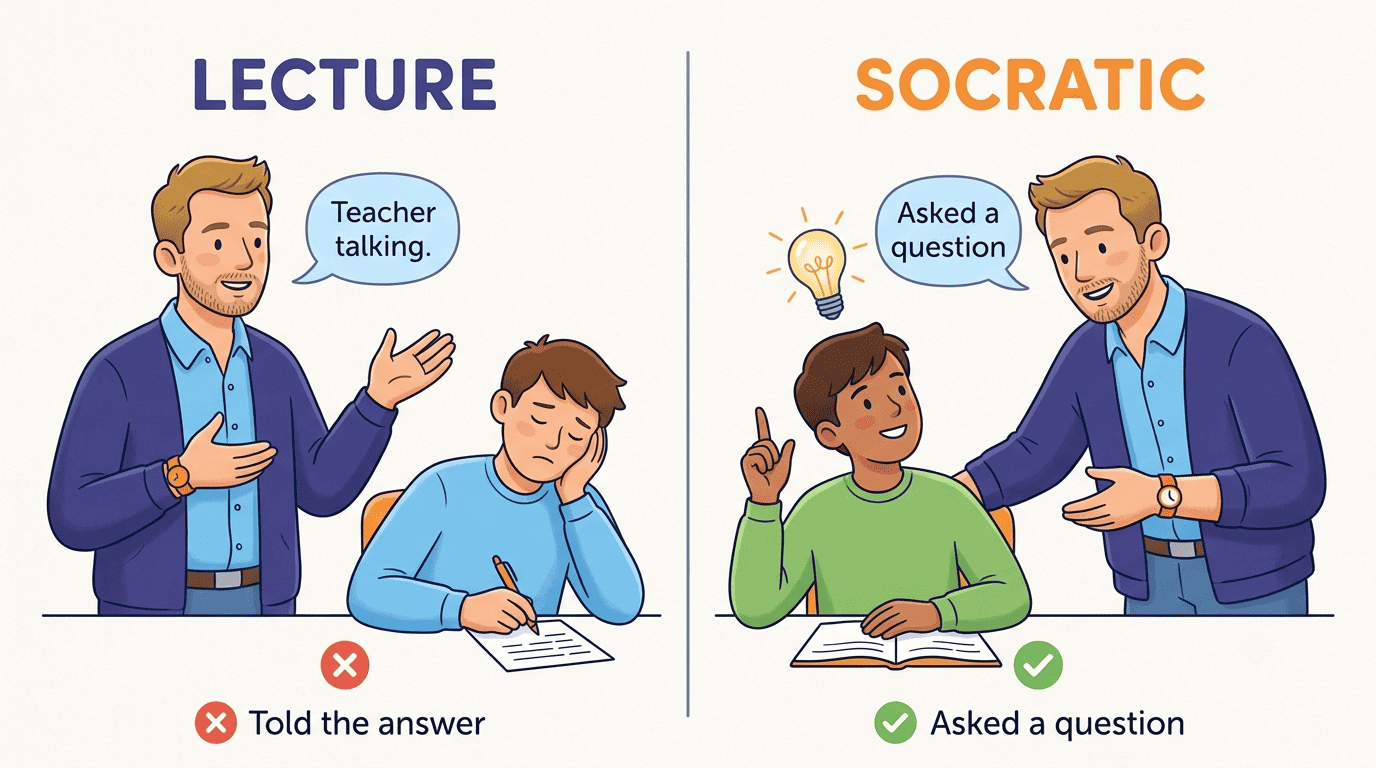
The Socratic method is teaching through questions rather than lectures. The teacher doesn’t hand over a conclusion — instead, questions expose the gaps and contradictions already sitting inside the student’s own reasoning, a technique known as elenchus, until a sturdier understanding replaces the shaky one. Socrates ran this in the streets and gymnasiums of Athens; Leo, the character behind an AI-powered teacher, runs the same loop in a chat window. Neither one starts by telling the student they’re wrong. Both start by asking what the student thinks, and why.
From Athens to your screen
Socrates never wrote any of it down — everything we know comes through Plato and Xenophon, filtered through his famous claim that he knew he knew nothing and so had nothing to lecture about. The method outlived him by roughly 2,400 years, migrating into law school Socratic seminars and bedside teaching rounds in medicine, both of which still run on cold-call questioning rather than answer delivery. What changes with an AI teacher is availability: the same interrogation that once needed a philosopher standing in the agora now runs at any hour, for as long as the student wants to keep going.
How an AI Teacher Runs a Socratic Dialogue
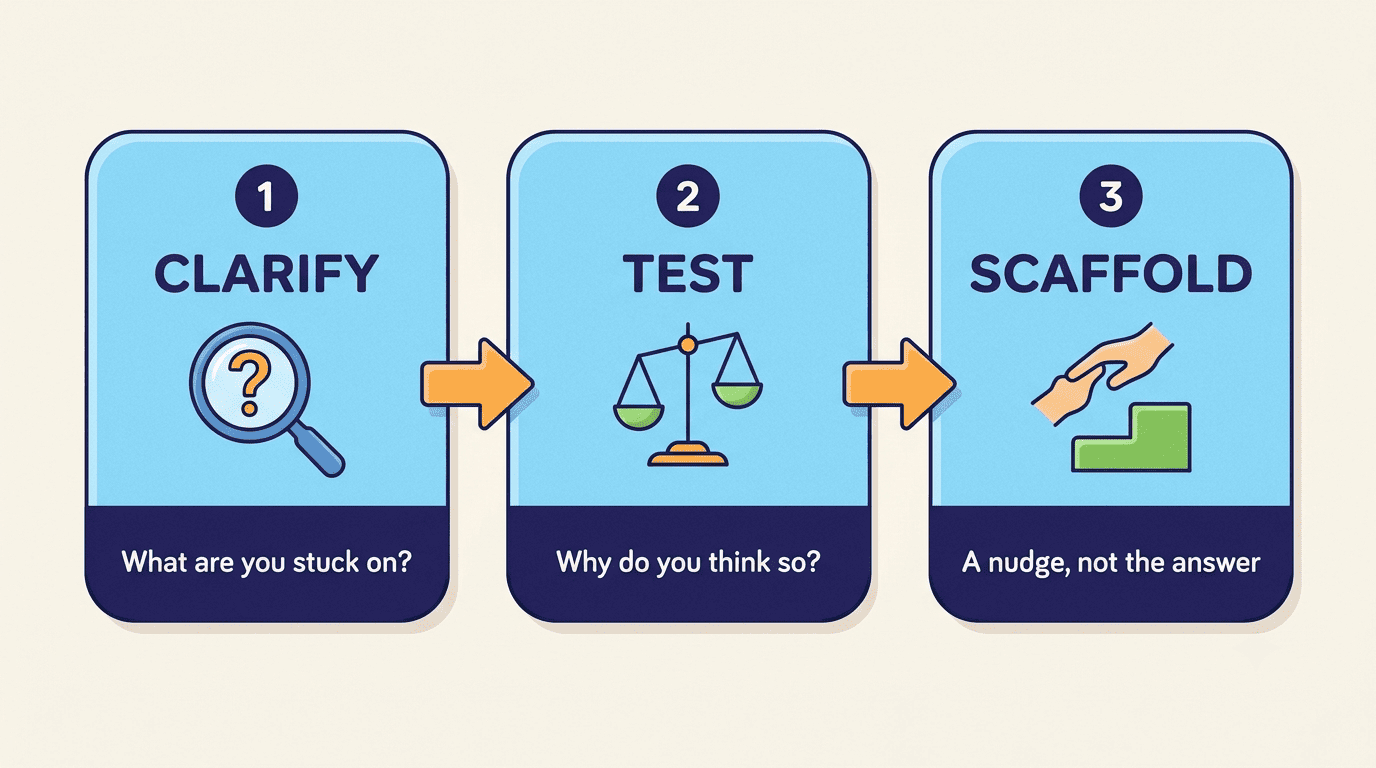
This is the mechanical core of the approach — how a chatbot turns “give me the answer” into a conversation that goes somewhere else. A personal AI teacher generally moves through the exchange in three deliberate steps rather than jumping straight to a solution.
The three moves: clarify, test, scaffold
Clarify comes first: “What exactly are you stuck on?” forces the student to locate the actual gap instead of restating the whole problem. Test follows: “Why do you think that?” or “What evidence supports it?” pushes the student to defend a claim they may have made on autopilot. Scaffold is last, and it’s the one that separates a Socratic tutor from a stonewalling one — a small nudge, not the missing piece of the answer. Picture the exchange: a student writes “I think the derivative is zero here.” Leo asks, “What’s the slope of the curve at that exact point — does it look flat to you?” The student looks again, and answers their own question.
The hint ladder — help that never skips to the answer
The nudges don’t arrive all at once. They climb a hint ladder: general prompts first, and a direct fragment of the solution — even just one or two lines — only shows up around the third exchange, and only if the student is genuinely stuck rather than just impatient. Underneath that pacing, the AI is tracking what the student already understands and deliberately resisting the pull toward premature resolution, holding the answer back a beat longer than feels comfortable to either party.
The Questions It Asks: a Repeatable Pattern
Strip away the specific subject matter and a Socratic AI tutor tends to cycle through the same handful of question types, in roughly this order:
| Question type | What it does | Example prompt |
|---|---|---|
| Clarification | Pins down what the student actually means | “What do you mean by X?” |
| Assumptions | Surfaces what’s being taken for granted | “What are you assuming here?” |
| Evidence | Demands justification, not just a claim | “How do you know that’s true?” |
| Counterexample | Tests the claim against an edge case | “Is there a situation where this fails?” |
| Synthesis | Forces the pieces back into one coherent answer | “So how would you put that together now?” |
That clarify → justify → counterexample → synthesize arc is the repeatable skeleton underneath most AI Socratic tutor sessions — the surface wording changes by subject, but the sequence holds whether the topic is algebra, a history essay, or a coding bug.
Why Asking Beats Answering
Retrieval takes effort, and that effort is exactly what makes it stick — psychologist Robert Bjork calls this “desirable difficulty,” the idea that learning conditions which feel harder in the moment produce stronger long-term memory than conditions that feel easy. That’s the mechanism behind why a guided question outperforms a handed-over answer for retention, not just for engagement.
I neither know nor think I know.
Socrates, in Plato’s Apology (21d)
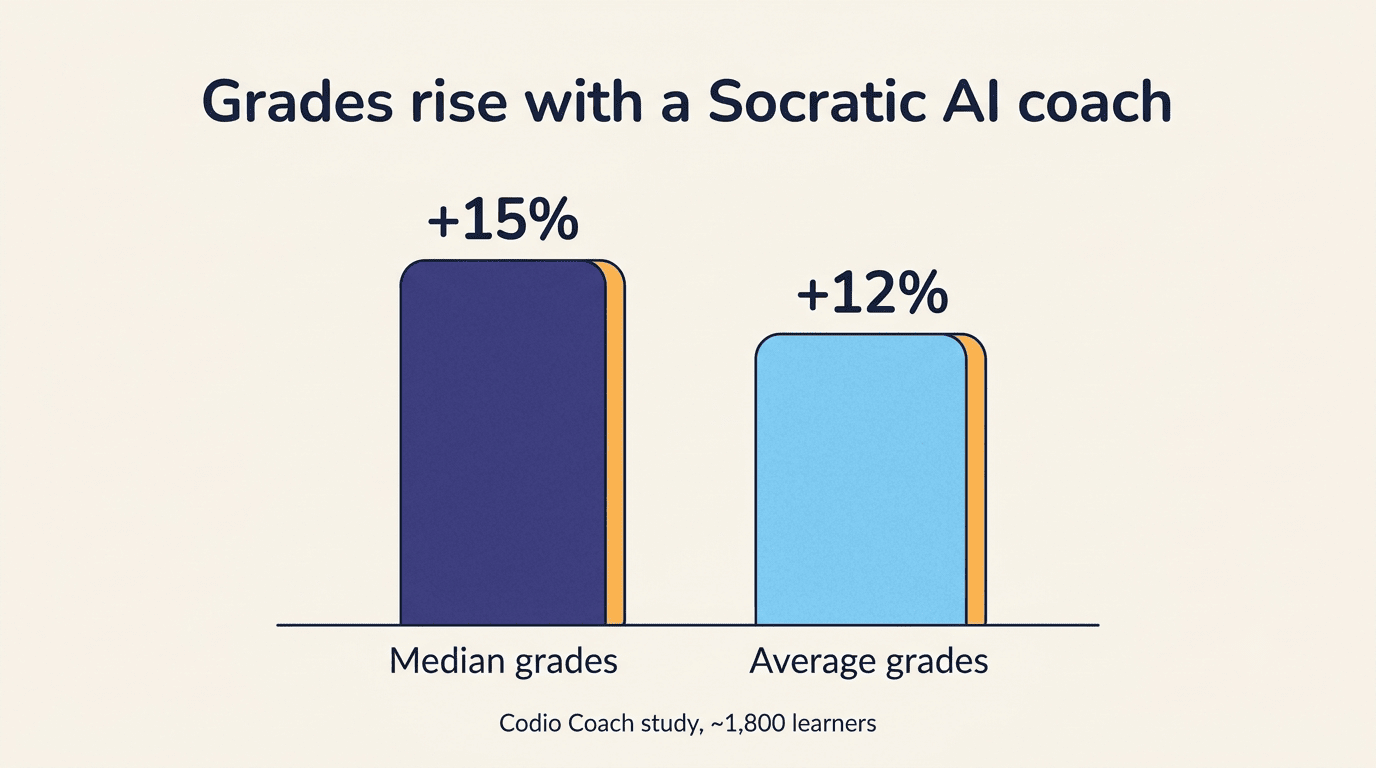
The numbers back it up. Codio’s own research, tracking roughly 1,800 learners across dozens of computer science courses, found median grades up 15% and average grades up 12% once its Socratic-style AI coach was added to the coursework. A 2025 Carnegie Mellon study of seventh graders found something related: students who got human tutoring on top of AI tutoring pulled 0.36 grade levels ahead of those using AI alone by year’s end. Intelligent Tutoring Systems research going back to Kurt VanLehn’s 2011 meta-analysis found the best automated tutors landing close to one-on-one human tutoring’s real effect size — a more modest number than the famous “two sigma” benchmark the field had spent decades chasing. A 2025 Frontiers in Education study comparing ChatGPT and human tutors found a split by field: engineering students were evenly divided between AI and human tutors, while humanities students still leaned toward people — but across fields, students consistently praised the AI tutor’s non-judgmental, always-available nature as a real advantage.
Here’s roughly how that plays out across a single tutoring session:
- Student states a claim or submits an answer.
- AI asks a clarifying question instead of judging it right or wrong.
- Student restates or defends the claim with reasoning.
- AI tests that reasoning with a “why” or “how do you know” question.
- If the student is still stuck after two rounds, the AI offers a small scaffold — not the answer.
- Student revises the claim using the new nudge.
- AI asks a synthesis question to lock in the corrected understanding.
Socratic AI in the Wild: Tools Already Doing It
This isn’t a theoretical framework sitting in an education journal — it’s already shipping in mainstream products, and researchers are racing to formalize it further. OpenAI’s ChatGPT Study Mode launched in 2025, built specifically around withholding direct answers in favor of guiding prompts. That same year, Harvard researchers published SocratiQ, a prototype learning companion built on the identical principle. Khanmigo, Khan Academy’s tutor, is built on OpenAI’s models and follows the same restraint: ask before telling. A personal AI teacher like Leo applies the identical discipline, just packaged around one student’s ongoing coursework instead of a general-purpose chat interface.
Where It Falls Short (and When a Straight Answer Is Better)
| Situation | Socratic questioning | Direct answer |
|---|---|---|
| Deep conceptual understanding | Strong fit | Weak — skips the reasoning |
| Simple factual lookup (a date, a formula name) | Slow and frustrating | Fast and appropriate |
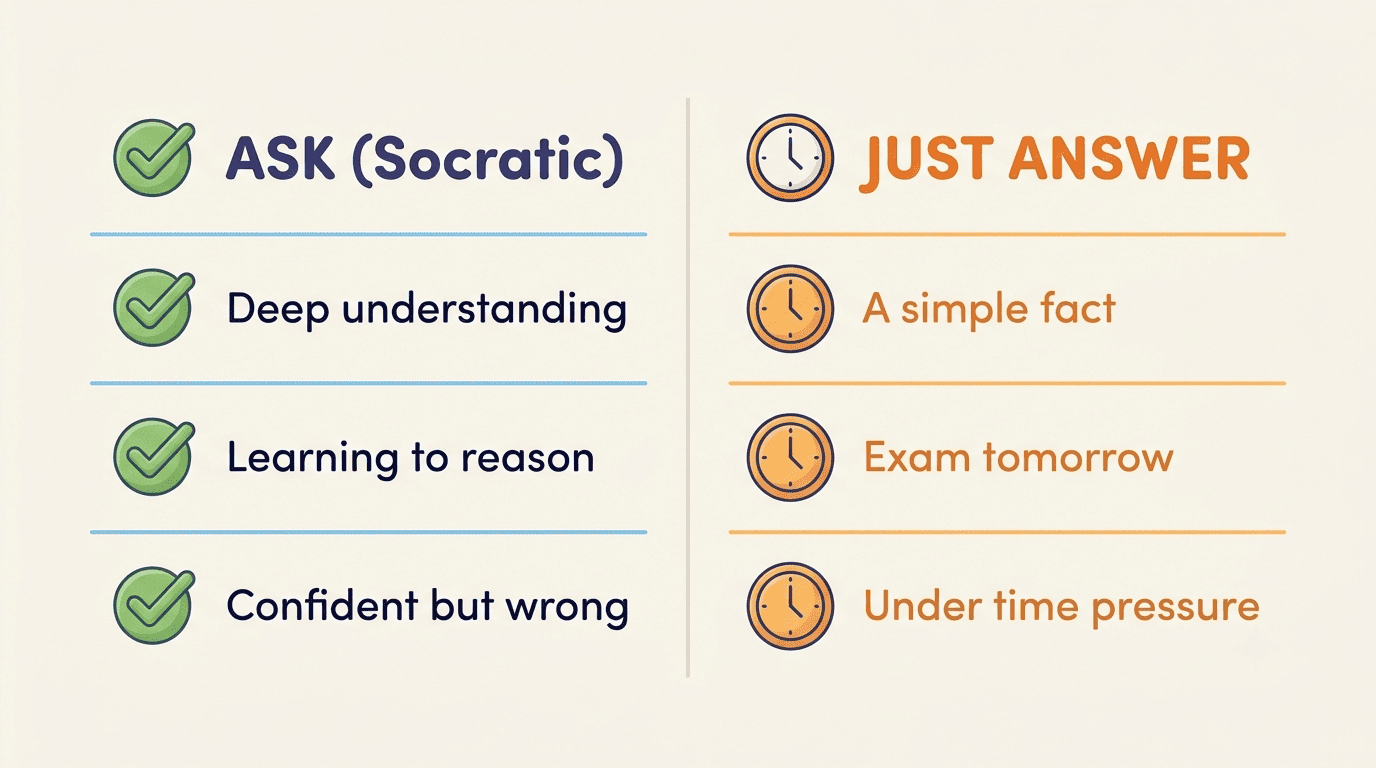
| Student under real time pressure (exam tomorrow) | Can backfire | Often the better call |
| Student is confident but wrong | Strong fit — exposes the gap | Risks reinforcing the error silently |
The method isn’t a universal tool. Under a genuine deadline, or for a fact that has no reasoning to uncover, a direct answer is simply more useful, and a rigid AI tutor that refuses to ever just answer risks becoming annoying rather than instructive. There’s also a real risk of over-reliance — students leaning on the questioning loop as a crutch instead of building independent judgment, sometimes described as a kind of cognitive scaffolding addiction. And the AI itself is not infallible: it can misjudge a student’s level, push a counterexample that doesn’t actually apply, or simply get a fact wrong. The same interrogation students learn to apply to their own claims is worth turning back on the AI’s output — asking what it’s assuming, what evidence backs its answer, and where it might be mistaken. UNESCO’s guidance on AI in education frames exactly this kind of oversight as central to using these tools responsibly rather than handing them unchecked authority over what a student learns.