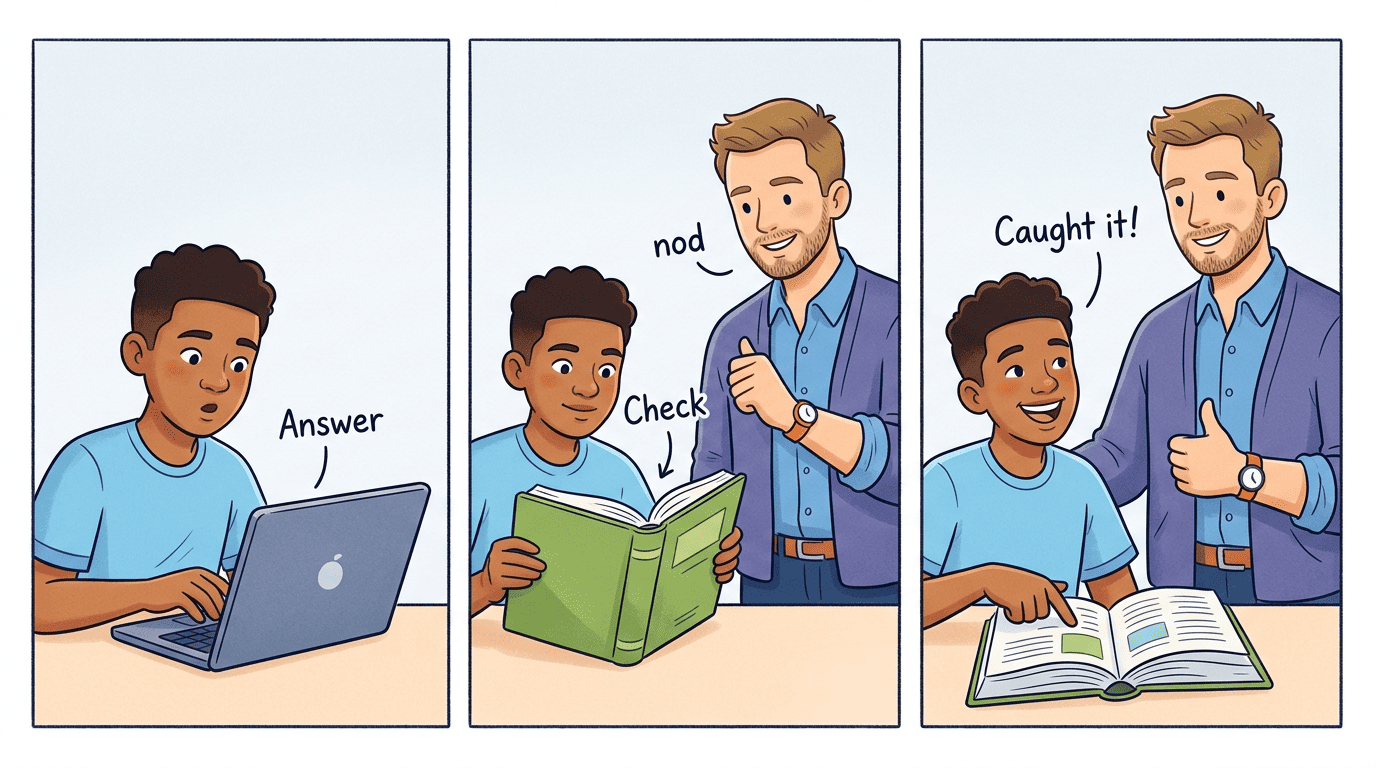
Are AI Teachers Accurate? Understanding AI Hallucinations and How to Verify Facts
An AI teacher like Leo can explain almost any topic in seconds — but even the best AI tutor can occasionally state something false with total confidence. That gap between “sounds right” and “is right” is exactly what this guide untangles, according to the Stanford HAI AI Index, which tracks how model accuracy has shifted year over year.
Here’s what you’ll walk away with: a plain-language explanation of what an “AI hallucination” actually is, why large language models produce them, where an AI learning assistant is most likely to slip, and a 60-second habit for checking any fact yourself. None of this is a reason to fear AI — verification is just a skill, and it’s one you can build quickly.
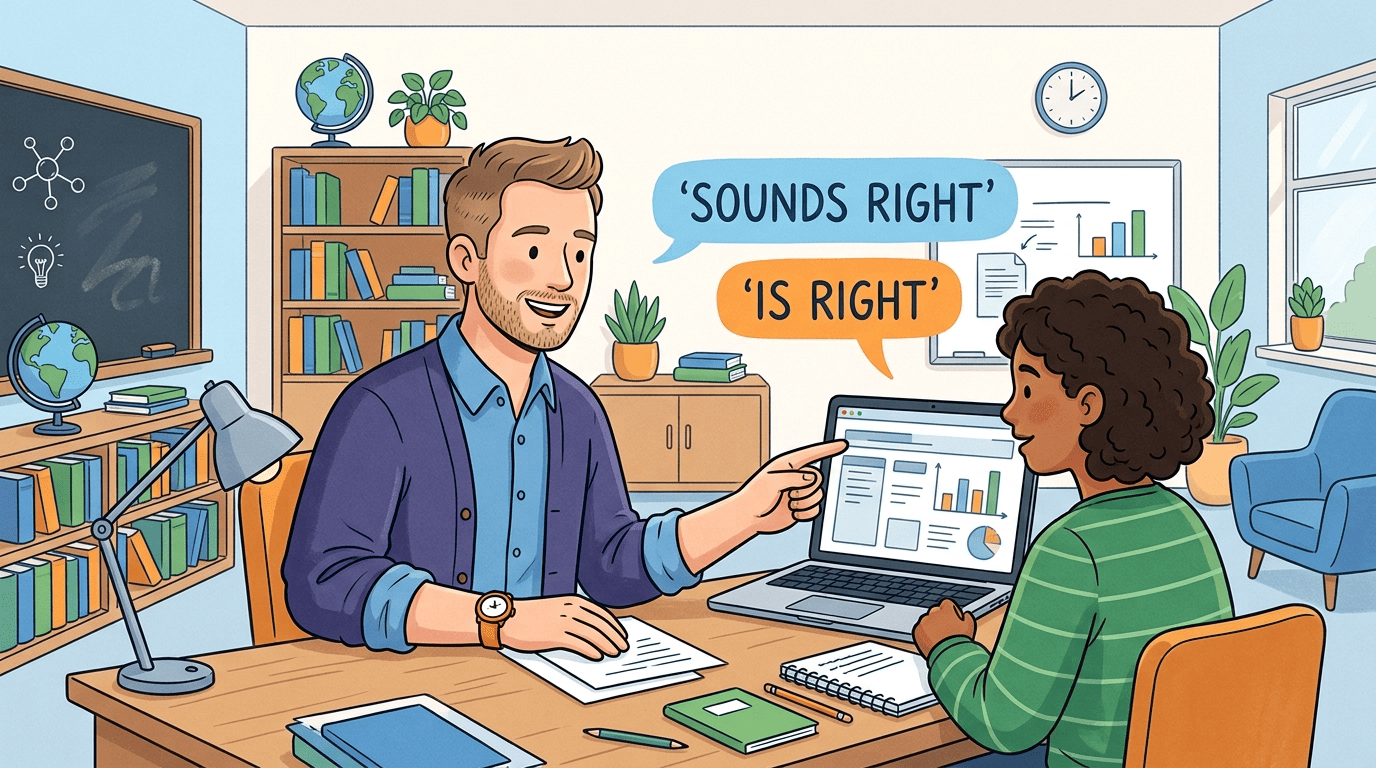
So, Are AI Teachers Accurate? The Honest Answer
The short answer is: mostly yes, with real exceptions worth knowing. An AI teacher draws on a large language model trained on enormous amounts of text, and for everyday schoolwork that training pays off — but it is not infallible, and it rarely sounds unsure even when it should be.
The good news: strong on the basics
Leo and other AI tutoring systems are dependable on standard curriculum material — basic math, core concept explanations, grammar rules, and well-documented historical events. These topics are covered so thoroughly in training data that a generative AI tool has little room to go wrong. For day-to-day homework help, review sessions, and concept explanations, accuracy is genuinely high, which is why so many students lean on an AI learning assistant as a first stop before a textbook or a search engine.
The catch: confident when wrong
The real problem isn’t that an AI teacher makes mistakes — it’s that it makes them in exactly the same confident tone it uses when it’s right. A large-scale study across 22 public broadcasters, coordinated by the BBC and the European Broadcasting Union, found that 45% or more of AI-generated answers to news-style questions contained at least one significant problem, and 31% had issues tracing back to sourcing. On complex, niche, or very recent topics, the error rate climbs further — expert reviews of specialized professional queries have found accuracy gaps in the range of 20–40%. That’s the pattern to remember: reliable on the familiar, shakier on the specific.
What Is an AI Hallucination?
A hallucinated response is any AI output that sounds plausible but is factually wrong or entirely made up. The term is now common enough that Cambridge Dictionary named “hallucinate” — in this AI-specific sense — its word of the year in 2023, a sign of how widespread the phenomenon had already become. It’s a useful mental model: the AI isn’t lying on purpose, it’s filling a gap the way a person might misremember a fact and state it anyway, minus the hesitation.
A simple definition
Picture an AI hallucination as fabricated information delivered with the same fluency as a correct answer. There’s no visual cue, no hedge, no asterisk — the sentence structure is identical whether the underlying fact is solid or invented, which is precisely why students need a habit of checking rather than a habit of trusting tone. For a deeper technical breakdown, Wikipedia’s entry on hallucination in artificial intelligence is a solid starting point.
The four kinds students meet most
Most hallucinations students actually encounter fall into a handful of recognizable patterns:
- Invented citations or sources — a book title, article, or study that doesn’t exist anywhere, presented as if it does.
- Misattributed quotes — a real quotation, but credited to the wrong person or the wrong work.
- Wrong statistics or numbers — a plausible-looking figure that’s simply incorrect, sometimes off by an order of magnitude.
- Confidently wrong interpretation — cause and effect reversed, or a small invented detail folded into an otherwise accurate explanation.
Each type looks harmless in isolation, which is exactly what makes them worth learning to spot.
| Hallucination type | What it looks like | Quick check |
|---|---|---|
| Invented citation | A source, book, or study that doesn’t exist | Search the title directly — no results means it’s fabricated |
| Misattributed quote | A real line, credited to the wrong person or work | Search the exact phrase to find its real origin |
| Wrong statistic | A precise-sounding number that’s simply off | Compare against a primary source or official dataset |
| Confidently wrong logic | Cause/effect reversed or a detail quietly added | Re-read the claim and ask “does this follow?” |
Why Do AI Teachers Hallucinate? (It’s How They Work)
Hallucinations aren’t a bug that a future update will simply switch off — they’re a side effect of how a large language model actually generates text.
Prediction, not lookup
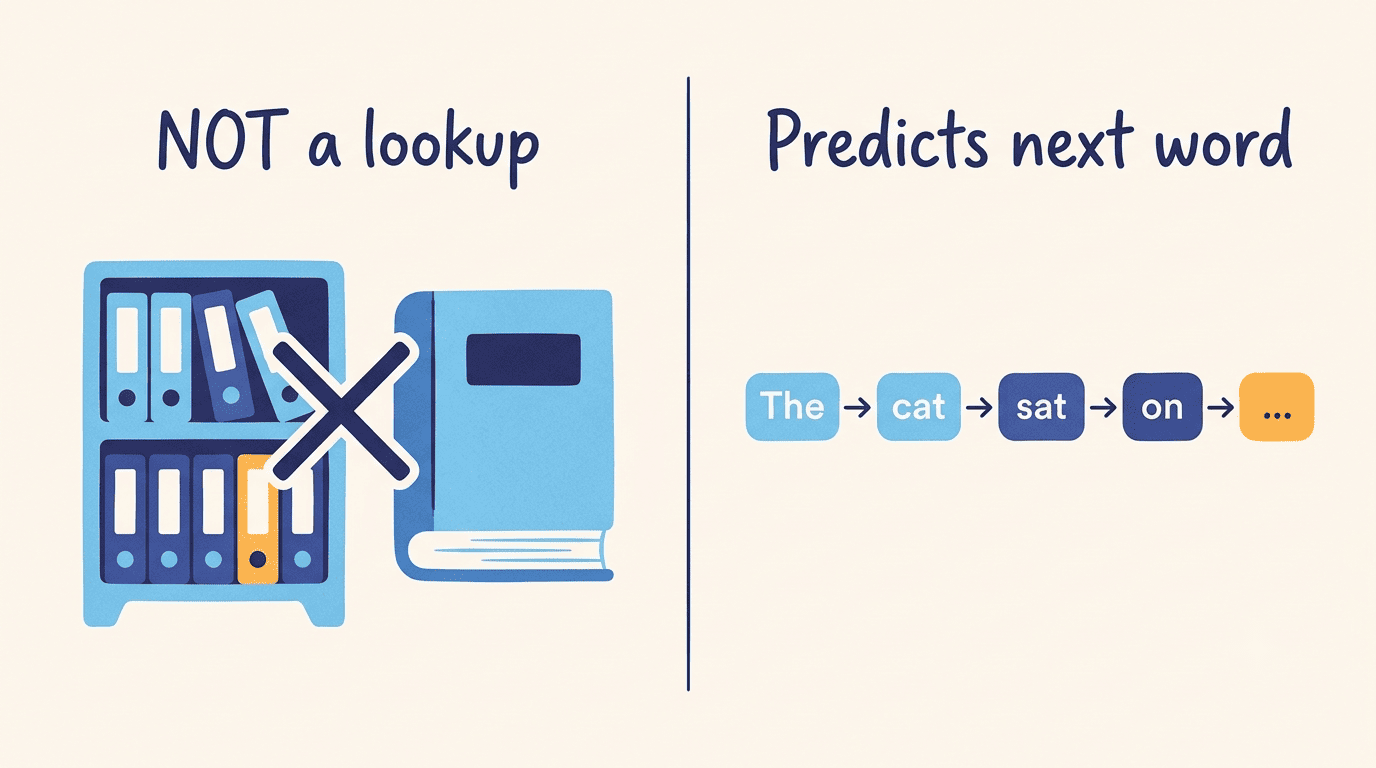
An AI teacher isn’t a database where the answer sits on a shelf waiting to be retrieved. It’s a Large Language Model that predicts the most statistically likely next word, one token at a time, based on patterns learned from its training data. Most of the time, the most likely word is also the correct one — language and facts tend to travel together. But when the model reaches a genuine gap in what it “knows,” it doesn’t pause and say so. It keeps generating a fluent, connected sentence anyway, because fluency, not certainty, is what the underlying prediction process is optimized for.
When the gaps get filled with guesses
Certain zones are riskier than others: events after the model’s training cutoff, narrow specialist facts, exact numbers, and precise citations. In these areas, the model is more likely to make what amounts to a strategic guess rather than admit uncertainty. This is also where a setting called temperature matters — a lower temperature (roughly 0 to 0.3) biases the model toward more predictable, conventional phrasing, while a higher temperature (0.7 to 1.0) trades that predictability for more creative, varied — and less reliably grounded — output. None of this is intentional deception; it’s simply the mechanics of the tool.
Where AI Teachers Are Most Likely to Be Wrong
Some categories of answer deserve extra scrutiny every time, regardless of how confident the phrasing sounds.
Fabricated citations top the list of academic risks. A 2023 review by Athaluri and colleagues found that of 178 citations generated by ChatGPT for medical writing, 28 didn’t exist at all. A related study by Bhattacharyya and colleagues examined 115 medical references generated by ChatGPT and found that 47% were entirely fabricated, with only about 7% both authentic and accurate. The consequences of skipping verification aren’t hypothetical either: in the 2023 case Mata v. Avianca, a lawyer filed a legal brief built on entirely invented court precedents generated by an AI tool, and the fabrication was caught only after the fact.
Numbers, dates, and anything from the last few months carry the same risk. Exact statistics, precise dates, and breaking developments are the second major danger zone, simply because they demand a level of precision the prediction process wasn’t designed to guarantee. It’s also worth knowing that language models can absorb and repeat AI bias present in their training data — another reason a second, independent source is worth the extra minute.
| Risk zone | Why it’s risky | What to do instead |
|---|---|---|
| Citations and quotes | Titles/authors are easy to invent plausibly | Open the source yourself before citing it |
| Exact numbers and statistics | Precision isn’t guaranteed by fluent phrasing | Cross-check against a primary source |
| Recent events | Falls outside or near the training cutoff | Verify with a current, independent outlet |
| Niche or specialist topics | Thin training coverage increases guessing | Confirm with a textbook or .edu/.gov source |
How to Verify Facts From an AI Teacher (Step by Step)
Fact-checking an AI answer doesn’t need to be slow. A short, repeatable routine handles almost every case.
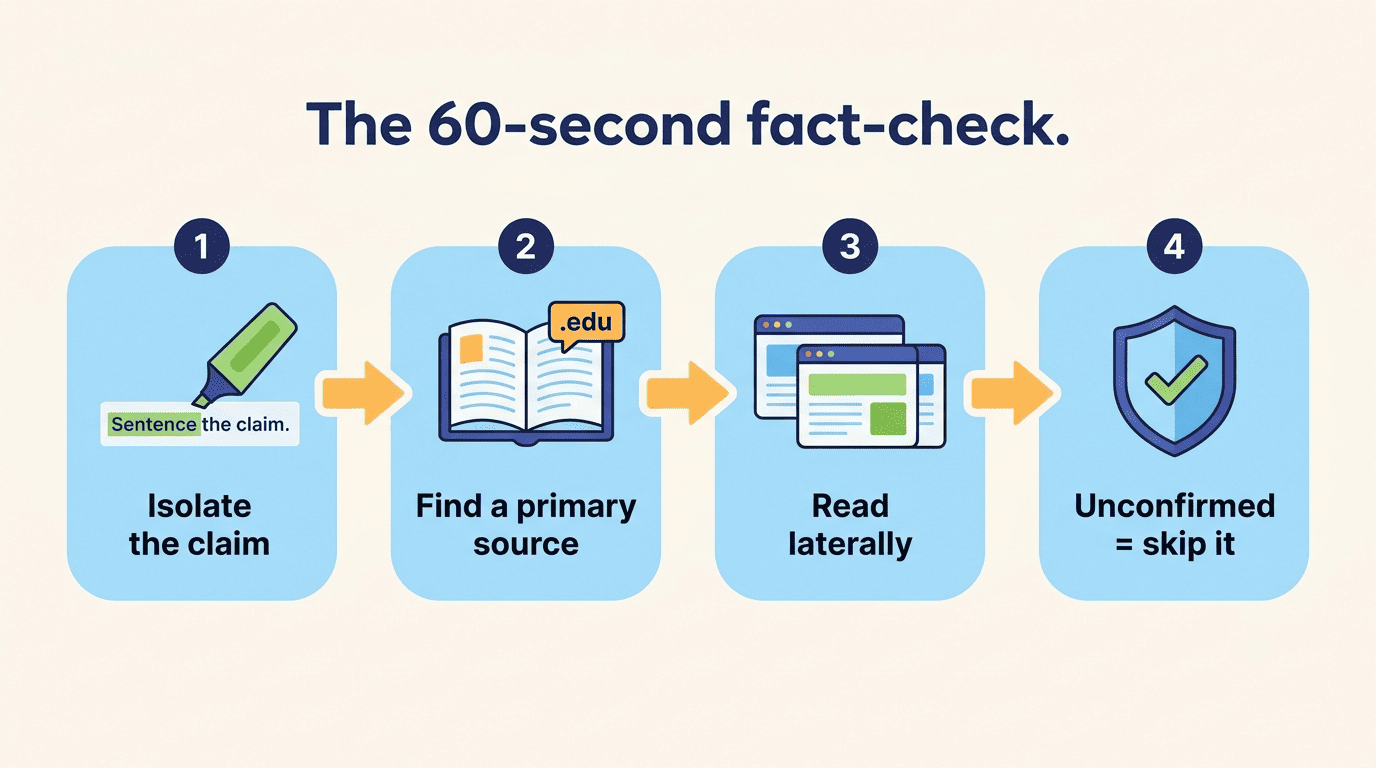
The 60-second fact-check
- Isolate the specific claim — a number, a name, a date, or a direct quote (opinions don’t need this step).
- Find an independent primary source — a textbook, an .edu or .gov page, or official documentation, not another AI-generated page and not the same chatbot asked twice.
- Practice lateral reading — open two or three independent tabs and compare what they say before deciding the claim holds up.
- Treat unconfirmed claims as false until a real source backs them up.
This is the core discipline behind lateral reading: instead of scrutinizing one page in isolation, you leave it and check what other independent sources say about the same claim.
Prompts that make AI show its work
A few prompts consistently surface more transparency from an AI teacher:
- “Provide 3 sources or links that support the answer above.”
- “Which parts of this answer are you least confident about?”
- “Rate your confidence in this answer from 1–10 and explain why.”
- “Answer only using the text I pasted, and flag anything you’re inferring.”
One caveat worth repeating: even links an AI teacher supplies need to be opened and checked, since a hallucinated source can include a hallucinated URL.
Tools that check citations
For academic work, dedicated citation checkers exist that cross-reference a source against a handful of trusted databases to confirm a DOI, ISBN, or reference actually exists:
- CrossRef — verifies DOIs for journal articles and academic publications.
- PubMed — confirms medical and life-science citations.
- arXiv — checks preprints in physics, math, and computer science.
- Open Library — verifies book titles, authors, and ISBNs.
These tools are a useful backstop for research papers, but they supplement — they don’t replace — actually opening and reading the source yourself.
As the U.S. Department of Education has noted in its guidance on AI in schools, human oversight and verification remain essential wherever AI-generated content informs a decision or a grade.
Generative AI tools should never be used as a sole source of truth; educators and learners alike need to verify outputs against reliable, independent sources.
UNESCO, guidance on generative AI in education
Turn AI Mistakes Into a Superpower: Critical Thinking
The goal was never to “catch” an AI teacher making a mistake and feel superior about it — it’s to build the checking habit itself, because that habit is useful for the rest of a student’s life, long after any specific tool is gone.
From “catching AI” to “checking AI”
This is a small but real shift in how AI literacy gets taught: instead of treating every hallucination as a gotcha, treat it as raw material for practice. Leo, as an AI teacher, can actually help with this directly — ask it to argue the opposite side of a claim, to explain both interpretations of an ambiguous fact, or to walk through exactly how it reached a conclusion. That back-and-forth borrows from the Socratic method: the value isn’t in the first answer, it’s in the questions that test it.
A quick classroom-style exercise
Try this the next time you use an AI learning assistant for homework: ask Leo a factual question, then explicitly request sources, then verify just one of those facts yourself using lateral reading. Notice what got confirmed and what didn’t. There’s no need to distrust the whole answer over one shaky detail — the point is simply to build the reflex. Every error caught this way is a skill exercised, not a reason to stop using the tool.